On Attachment:

Why are we so afraid of attachment?

“Don’t do it,” my cousin warned. “Don’t get attached.”

I laughed at him. He obviously didn’t have to worry about that.

But my laugh didn’t seem to convince him.

“You have no idea who she is – she could be crazy.” His warnings continued.

Valid point, I thought. I hardly knew her.


I had met her only a week previous, on the night of her birthday.

The mood was festive. Her sister was visiting and her friends were with her. The weather was perfect. Anyone could be a pleasure to be around in such a perfect setting.


“You could get hurt.”

I hated to admit it, but that one struck a chord.

He’s right, I thought, I could get hurt.


But sometimes we can’t shake the feeling that it doesn’t matter.

Sometimes we just can’t shake the feeling that we’ve found someone that we want to be attached to.

So when did we start to correlate suffering with attachment?


It’s a thought that sort of worked it’s way into the western mentality from its distant origins in the east.

The idea of dis-attachment is nothing new. Various Buddhist and Hindu sects have always determined attachment to be a major source of human suffering.

Attachment is the origin, the root of suffering; hence it is the cause of suffering.” The Dalai Lama at Harvard, 1988.

A very superficial understanding of the concept has worked its way into our psyche.

We see attachment as a bad thing.

It means opening up to the chance of losing something.

It means being vulnerable.

It means falling in love with a person who could take that love away from us at any time.

It means getting hurt.

But how much truth is there to this simple understanding of attachment?


I look around me, and I see that attachment makes up the very foundation of life.

On a purely molecular level, hydrogen molecules attach themselves to oxygen to form water – the elixir which makes life possible.

The biological attachment of man to woman creates life, and the attachment of a mother to her child is what allows that child to survive infancy – as her mother cares for the child out of that attachment.

The tides of our oceans are intricately attached to the gravitational pull of our moon, which in turn is attached to the pull of the earth, which spins happily in its attachment to the sun and our solar system.

The bloom of the African lilly is forever attached to the spring for the perfect conditions, the bees for its pollination, and the sun for it’s nurturing kiss.

In an infinitely interconnected universe, attachment is creation.

Attachment is life.
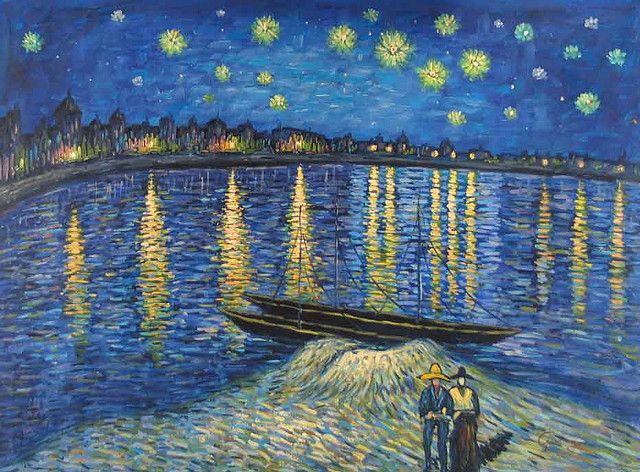

08e2929ba8f63e95f13c89b8c8b28afa
Starlight over the Rhone Near Arles [1888] by Vincent Van Gogh.
And yet attachment can be a dangerous thing.

It is when our attachments are based on reliance that it has a high propensity to cause suffering.

It is when we fill the void inside of ourselves with attachment that those attachments gain the power to hurt us.

It is when we attach ourselves to the love of others rather than the love of ourselves that our attachments become toxic.

It is when we attach ourselves to the acceptance of our peers rather than ourselves that our characters become weak and dependant.


Someone close to me always says that you have to fill your own cup. It is when our attachments fill our cups that they become dangerous, because at any moment we may lose them.

This leads to cycles of loss and gain, unbalanced relationships of power and reliance, and, for the most part, pain.

That is the lesson of the west, the lesson of the Buddhists and the Hindus. We mustn’t attach ourselves to sources of love and happiness that we should be getting from our own heart and souls.


But fearing attachments because we may lose them is only weakness.

It is a fear of loss.

It is a fear of being hurt.

It is a fear of not being worthy.


But we are worthy of love.

We are worthy of acceptance.

We are worthy of real, committed relationships.


Allowing ourselves to become attached is one of the greatest forms of vulnerability that we can demonstrate to each other.

The more attachments we have, the more we’ll lose.

The more we’ll suffer.

But that pain is the price we pay to live life to the fullest.

To avoid pain and live life in solitude is the life of a monk.

It is the absence of vulnerability, and it is the absence of the awe and wonder our indulgence in this human experience provides us.

It is human to be vulnerable.

It is human to attach.


The vulnerability that we demonstrate in attaching ourselves to another forces us to dive deeper into ourselves.

It is an essential journey into finding out all the intricate details about ourselves – the good, the (not so) bad, and the things we need to work on that we would have never noticed otherwise.


But finally, it teaches us acceptance.

It teaches us to accept ourselves as perfect just the way we are.

It teaches us to accept another as just as perfect.

It teaches us to accept that we may lose that person or thing at any moment, and that’s okay.

In fact, it makes that person or that thing even more valuable and beautiful because we may lose them tomorrow.

In the acceptance of eventual loss we find appreciation.

We find gratitude.


We’re not perfect. We never will be.

We will struggle to reach that higher place of existence for the rest of our lives.

But we can learn to be happy by ourselves.

We can learn to love and accept ourselves.

And along the way, when we get that undeniable feeling that we’ve found someone we want to attach ourselves to, we’ll be absolutely fearless when we do it.

Be good to each other,

– MG.

On Goodbyes:

Goodbyes are a beautiful thing.

I’ve never been the best with goodbyes; I don’t think many of us are.

It might be why I’ve come to dislike airports as much as I do. If you’re in an airport, you’re saying goodbye to someone, or something, in some way or another.


Part of me wonders why we put ourselves through these types of feelings.

And here I am, in another airport. I’m looking around and watching the goodbyes everywhere. Sisters holding each other tightly in an embrace. A father holds his little boy who is crying because he’s leaving. Lovers hold hands until that final, desperate moment.


The older I get, the more I realize that every goodbye could be the last we have with that person.

And yet I realized today that it’s for that reason exactly that goodbyes are a beautiful thing.


In a little over an hour waiting to board my plane, a million memories of the person I had just said goodbye to flooded my mind.

I felt a strong appreciation for all of the times I was lucky enough to spend with her. I laughed aloud at the many good memories, and replayed with understanding and compassion the uncomfortable ones. I found myself momentarily regretting all of the times I wasn’t completely present in the moment with her.


The experiences with our loved ones are special because we have to, at some time or another, say goodbye to them. With this in mind, each moment becomes a singular treasure to be cherished and appreciated.


I used to want to live forever. I wanted my friends and family to live forever. I wanted to stay close to home. I didn’t want to say goodbye.

But what would relationships be worth if we were not doomed to one day say goodbye?


So spend time with those you love. Connect with them on the deepest levels. Laugh off the perceived issues and embrace the great times.

Stay completely present, because one day you’ll say goodbye.

And that’s a beautiful thing.

Be good to each other,

– MG.

On Frustration:

How frustrating is being frustrated?

The human experience can provide many opportunities for frustration. At times it can feel like the entire world has turned its powers of gravity against us; nothing is going our way.

We struggle against this tide, and yet it grows stronger.

And yet I call them “opportunities” for frustration, because as much as they seem like inescapable issues at the time, every single one is the result of actively choosing to be frustrated by something.


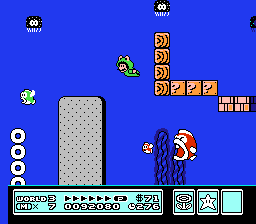
I think back to my childhood. I would be minding my own business, swimming through Super Mario Bros 3 in my frog suit, when my sisters would decide to start a conversation with me, or show me the hairstyle they gave Barbie.

Next thing I know, I’m dead and the frog suit is a thing of the past. I would immediately lash out at them, claiming they “made me die.”


Smb3_10
Super Mario Bros 3

As we grew a bit older, both sisters still provided daily doses of frustrations. One would play music that annoyed me, the other would watch television shows precisely when my show of choice was on.

We all have that guy in the gym who “distracts” us with his grunting, or the construction crew that has been working a little to long just outside our apartment window.


Just as I did with my sisters, we take these inconveniences as personal slights.

We see the guy in the gym as purposely grunting for attention, or the construction crew making noise just to bother us.

The guy who cut us off made us miss that light to make us late for work. The cop gave us that ticket to ruin our weekend.

As though I was the centre of the universe, I believed my sisters intentionally infringed on my comfort.

The fact is, people are doing their thing. They are the pilots of the spacecraft navigating their own little personal universe.


The moment I stopped taking things personally, the easier it was to let things go.

The construction crew doesn’t know we exist. The guy in the gym is in the zone. My sisters had no idea I was home from hockey, or school, or hanging out with friends. The cop was doing his job.


Things will happen to us every day, and that’s a good thing. I would feel like I had been robbed of this amazing experience we call life if every day wasn’t a complete random series of events.

But it’s how we interpret these events that matter.

We can struggle against the current, and fight it until we’re tired, frustrated, and angry at the world.

Or, we can float downstream and worry about the things we can control.

For nothing can frustrate or annoy us without our complete and explicit permission.

Be calm.

Be Zen.

Be good to each other,

-MG.


What a Time to be Alive!

What a time to be alive, indeed!

What a time to be alive!

In a time when parents no longer take responsibility for the education of their children.

A time when the children – those who will someday lead us into the future – are subjected to the cruel and inhumane punishment known as public school.

A place where the boring, limited, and inadequate lesson plans leave young scholars uninterested in learning and intellectual growth.

A place where those children who are blessed with strong spirits and who are full of passion are often reprimanded for their inability to sit and learn in such rigid settings.

A place that values the memorization of information over the learning and understanding of it.


getty_rf_photo_of_boy_writing_on_blockboard
[Source: http://www.webmd.com ]

What a time to be alive!

In a time when an infinitesimal portion of the population controls the vast majority of the world’s wealth.

A time when the majority of the population lives below the poverty line.

A time when many are completely reliant on government subsidies to survive, although that welfare rarely covers the expenses of basic necessities.

A time when the middle class is consumed in a cycle of barely keeping their heads above water, being considered too rich for financial aid but barely making enough to pay the bills.

A time when lawsuits are rampant, lawyers are the destroyers of the law, and justice has been twisted into a profit driven business.

A time when alcohol abuse amongst the masses is commonplace, serving as a popular escape from the grey clouds of life.

A time when the self-indulgent elite live for material accumulation and thrive off petty gossip during their elaborately wasteful dinner parties.

A time when breakfast and lunch are eaten on the go, or neglected all together, as the daily grind demands early mornings and busy lunch hours.

Our time is more valuable than our health.


235
[Source: http://www.homeless-oftheworld.com ]

What a time to be alive!

A time when economic factors are driving farmers off of the family farms they’ve worked for generations and into the crowded cities.

A time when those in power are forced to spend wastefully on unneeded construction projects to create low-skilled jobs in order to keep the flawed economic system above its breaking point.

A time when theoretically there is a chance for the upward mobility on the social and economic ladder, but in reality many children will earn less and live worse than their parents.


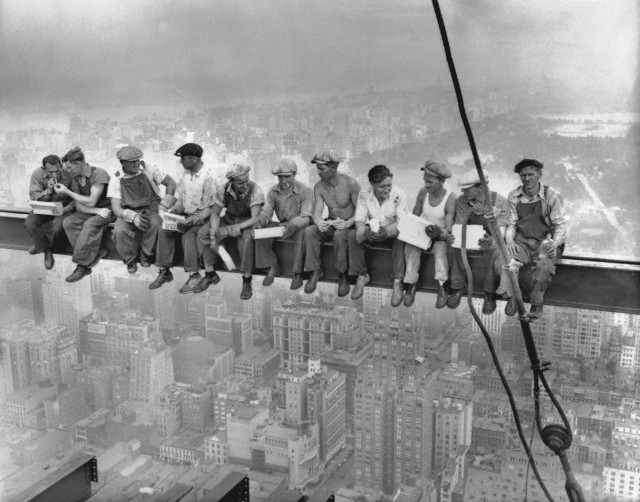
New York Construction Workers Lunching on a Crossbeam
“Lunch Atop A Skyscraper” 29 Sep 1932 — Construction workers eat their lunches atop a steel beam 800 feet above ground, at the building site of the RCA Building in Rockefeller Center. — Image by © Bettmann/CORBIS

What a time to be alive!

A time when conservatives vilify and berate religions different to their own, and who campaign against sexual orientations different to their own.

A time when the dire economic status of many people pushes them towards religions that promise salvation and riches after their death, in exchange for absolute and radical servitude during their life.

A time when the equal status of women is a hot point of argument between religions.

A time when minorities are granted superficial rights, statuses, and titles but are never truly treated as equals.

A time when the act of marriage is openly mocked, and adultery is so rampant that many people believe that no one can be faithful.

Adultery
[Source: http://www.listland.com ]

What a time to be alive!

No, I’m not talking about today.

I’ve just described the daily life of Romans during the Antonine Dynasty, nearly 2000 years ago (138-193 AD).

Those social, educational, religious, and economic issues led to the collapse of Rome.

The world crumbled into 500 years of darkness.


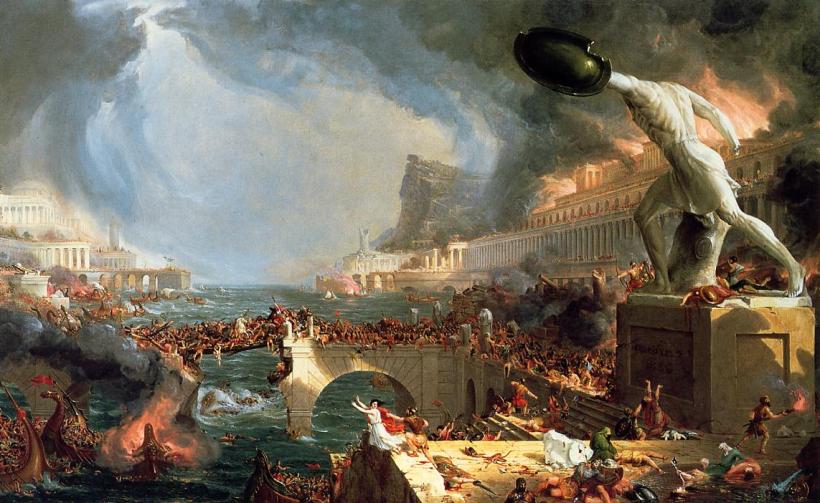
the-course-of-empire-destruction-thomas-cole-1836
Destruction [1836] by Thomas Cole.

But these issues all seem a little familiar, don’t they?

Of course they do, because they are the very same issues we struggle with today.

Are we really evolving as human beings?

Or is the path we’re walking one we’ve already walked before?


Luckily for us, we are not doomed to repeat our mistakes.

As a few warrior poets close to my heart once wrote:

There’s still time to change the road you’re on.” – Jimmy Page / Robert Plant, Stairway to Heaven.

Maybe it’s time we learn from history, rather than just repeat it.

Be good to each other,

– MG.

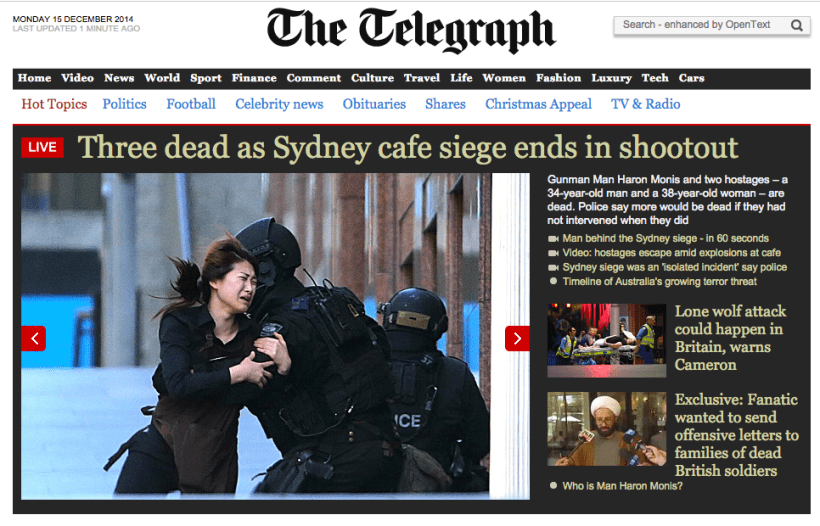
On The Sydney Siege:

A year has passed since tragedy struck Sydney; What have we learned?

Horrific events such as those which took place in Sydney a year ago, and those seen in Canadian parliament a few months before it, make it easy to lose (at least a little) faith in humanity.

 They make it is easy to generalize.

It becomes easy to blame and to point the finger.

It becomes easy to hate.


Yet as easy as it is to become less humane, it is not the reaction I witnessed in the aftermath of the Sydney siege.

I saw Australia come together as a people, no longer bound by any political, ethnic, or cultural differences.

I saw the brave men and women of Australian law enforcement sail into a storm of bullets attempting to save people they had never met.

I saw people of all religions rally around the hash tag #IllRideWithYou, supporting those beginning to feel ostracized by their faith – which extremists’ constant misrepresentation has sullied with a crimson stain – to continue to freely and without fear commit themselves to their God and their religious beliefs.


16030631636_5afee6ced5_b
The warriors of love made their mark at Martin Place. [Source: http://www.photoforum.com.au ]

I saw candles lit for the safe keeping of those taken hostage, brothers and sisters we knew could be our own.

I saw a country – and a global community – in mourning for a son and daughter taken too soon. We willingly made their families’ pain our own.

I saw, if even for a moment, how beautiful humanity can be at its best.

For at least a day, I saw us no longer blinded by a veil of ignorance. We were – all around the world – simply human.

That universal empathy for the human struggle was alive in all of us. We had no idea of the races, religions, or cultural dispositions of those taken hostage. Yet we feared, hoped, and prayed for them in earnest and with a single voice.

Most importantly, that love exclusive to humans – the one which transcends space and time, life and death – beat louder than ever in how we responded. We were a singular beat in a united human heart.

It is always difficult to look past the hate, to see light in the darkness. Sydney was no different. Why is this so?


Because love isn’t as jarring as a black flag pinned against a shop window, held up by victims terrified for their lives. It isn’t as easy to sensationalize as a man driven by darkness, willing to cause pain and suffering to pursue his own deranged motives. It isn’t as loud as early morning gunshots shattering the innocence of a peaceful nation.


_79730565_79730564
The jarring image that many of us remember. [Source: http://www.bbc.com ]

But isn’t that what makes love such a special thing? It isn’t easy to find. Its rarity is what makes love precious.

We see glimmers of it in the passing smiles of strangers and in the laughter of children before it drifts away on the changing winds of the seasons.

We too often let hatred and prejudice bury love next to our slowly eroding humanity. But we didn’t on that Monday a year ago.

Instead, we came together.


What happened in Sydney was not a demonstration of the deterioration of humanity through hatred and social division.

It depicted a single lost soul who had allowed himself to be corrupted by the evils of fanaticism.

My heart aches for all of those who are mourning the loss of those we lost on this day a year ago. Yet it hurts more to think that the memory of them will be tainted by associations with the evil which manifested itself in the form of a broken man.

Instead let us remember the lessons of love that came from their deaths.

Let us remember the brave men and women who risked their lives trying to save them.

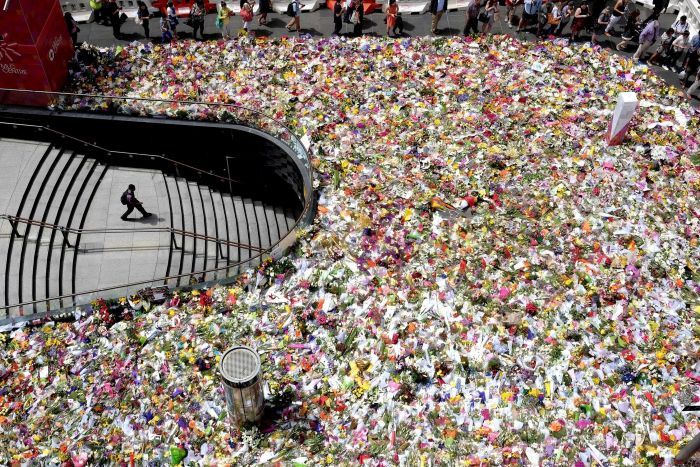
The thousands upon thousands of complete strangers who turned an entire Sydney square into a garden of Eden by filling it with beautiful flowers, paying their respects to people they had never known.


5976704-3x2-700x467
Australia turned a site of horror into a garden of beauty and love. [Source: 702 ABC Sydney: John Donegan ]

The coming together of all races and religions in astounding candlelight vigils full of love and empathy.

The memory of those lost must be remembered for what that event showed us.

It demonstrated how truly powerful love can be when we fight all the prejudices suffocating it. That is how we can honour their memory. That is how we must make sense of such mindless and depraved acts of violence.

Darkness cannot drive out darkness: only light can do that. Hate cannot drive out hate: only love can do that.” – Martin Luther King Junior, A Testament of Hope: The Essential Writings and Speeches.

We must remember the phoenix as it shines brightly in the night sky, not the pile of blackened ash from whence it came.

Love, like happiness, is not a singular end that can be obtained. It is constantly struggled for; it is a way of life.

Love is a beautiful war, and the Sydney siege showed that together we can win it.

Be good to each other,

– MG.

On Death:

What is it about death that actually scares us?

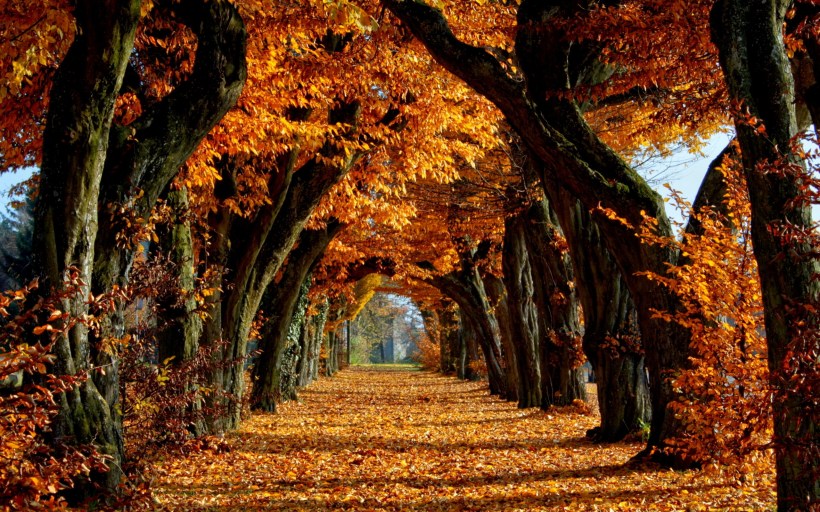
When I was growing up, I always took great delight in the autumn season. I’m not sure if it was because my birthday was coming up, hockey season was around the corner, or simply because of the beauty of the Canadian wilderness in fall.

The ordinarily green landscapes would be stroked orange, red, and yellow by the paint brushes of the gods. Fields full of grass became oceans of amber. Bronze sunsets would tint the city gold and set the sky ablaze.

And yet, everything around me was dying.

Autumn
A Canadian Autumn [Source: canadianmusichalloffame.ca]

It’s curious to think that I don’t know of a single person who has wept for fallen leaves, or wilting flowers, or dying grass. We innately understand this is the way of things. We know that spring will come, and the cycle of life (and death) will renew itself.


Why then, do we fear death? Why do we see our own death as the end of the straight line we’ve travelled since birth? Why is it so uniformly regarded as something negative?

Whether we’re afraid of what comes next, or dying painfully, or just the thought of our lives ending, it’s the ultimate boogeyman in the human experience.

Even the Romans, as battle hardened and fearless as they were, refrained from uttering the word “death.” By doing this, they gave power to the very word.

Death is certainly a part of life, and is certainly inevitable. It comes for us all. Does this give it power over us?

Of course not. We do not fear sunsets and sunrises, we do not fear the passage of time, we do not fear breathing. Yet these things are all inevitable. Inevitability doesn’t give something strength, but fear does.


The fear of death is death’s only weapon against us. Like the monster under our bed, it grows in ferocity and size as long as it remains the great unknown. In tackling the fears that surround death, we free ourselves from its grasp.

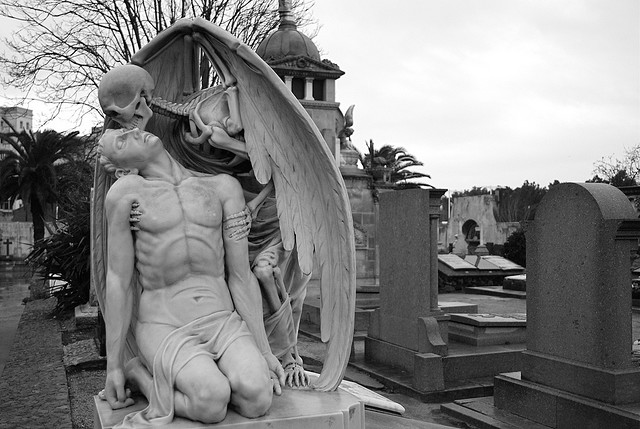
kiss of death poblenou barcelona 3
The Kiss of Death statue in the Graveyard of Poblenou, Barcelona, Spain. [Source: http://www.kuriositas.com]

Why, exactly, do we fear death?

(1) We fear death because we don’t know when it may come.

We fear the idea of dying young. 

I think of Jimi Hendrix, Alexander the Great, Amy Winehouse, Frédéric Chopin, John Keats, Tupac, and Tutankhamun. They all died at extremely young ages. Yet I would be willing to bet they lived lives more rich and full of experience than many of us rotting away in a cubicle.

On the grand scale of time and space, the difference between living 30 years and 80 isn’t even a blip on the map. Whether we die old or young we’re only here for an infinitesimal period of time, a period of time we cannot control.

We only have the power to make those years count.


(2) We fear death because we don’t know what comes next.

If I’m being perfectly honest, I usually have no idea what day of the week it is without ample reminders. Every day is a surprise. I’m at peace with the fact I generally have no idea what’s coming next.

We didn’t know what came next when we escaped the womb and came into this world kicking and screaming. We didn’t know what came next when we shipped off to university.

Sure, there was a little nervous energy, but we were generally excited about that great unknown. It was all new and beautiful.

Life can change in an instant, and that’s exactly what death is – life changing in an instant.

Whether death is the start of a new life or the end of an old cycle, change is never something to be feared.

It is only our concern with what may come in the future, or what happened in the past, that binds us to the wheel of life and death. By remembering that the present moment is the only moment, we free ourselves from that ever spinning wheel.


(3) We fear death might hurt.

I think I can speak for all of us by saying life usually hurts. Breaking bones was a price of playing the sport I loved, for example, and I broke pretty much everything above my waist – twice.

We’re riddled with coughs and colds and aches and pains and pimples and gas. We battle the seasons; we’re freezing in the winters and choking on smog in the summers. The suffering of life is unavoidable.

It seems a bit absurd to worry about the suffering of death, when our suffering is constant and unrelenting in the life we’re living. As far as we know, death is a release from our daily human suffering. Death is the absence of pain.

I’ve seen many people and animals suffer in life – but have never seen one struggle in death.


Nothing can be grievous which occurs but once; is it reasonable to fear for so long a time something which lasts so short a time?” – Michel de Montaigne, How We Weep and Laugh at the Same Thing.


I often wonder if a rose would be as beautiful if it were perpetually in bloom, or if we would cherish the springs if there was no winter. Life isn’t beautiful because it is long, or painless, or safe.

Life is beautiful for the simple fact that we are mortal. Death is what makes life a special gift. Every moment can be our last. For this reason, everything we touch, smell, hear, taste, and see is magical.

Death is our constant reminder to appreciate this life that we’ve been given.

Appreciate the people around us, the things that we have, and the healthy bodies we’ve been given.

Memento mori.

Be good to each other,

– MG.


On A Moment of Clarity:

Sometimes we’re in the right place, at the right time, with the right book.

I had finally arrived home, just ahead of the sunset. Exhausted, I dropped onto the couch with a sigh.

The rain sputtering on the window reminded me that I was sitting in wet clothes, but I was too tired to care.

Looking around the room, a book on a nearby shelf that was collecting dust caught my eye. I had bought it some time ago, on a whim of no real design, and it had sat there neglected ever since.

As we sometimes do, I flicked absent-mindedly through its pages; I landed on book number two. A certain paragraph seemed to stick out off of the page, a little further than the others.

I ran my fingers along the black lettering. It seemed to be bulging from the paper as though it was braille. I can still remember my eyes actually growing wider with a desperate gluttony as I began to hungrily devour the words presented before me:

Remember how long you have been putting this off, how many times you have been given a period of grace by the Gods and not used it. It is high time now for you to understand the universe of which you are a part, and the governor of that universe of whom you constitute an emanation: and that there is a limited circumscribed to your time – if you do not use it to clear away your clouds, it will be gone, and you will be gone, and the opportunity will not return.” Marcus Aurelius, Meditations.

I had always heard of people having a moment of clarity, which also happens to be my favourite Jay-Z song of all time, but I had never experienced one myself.

You always hear people say that when you’re truly in love, you’ll just “know” it. The same people say if you’re unsure if you’ve ever been in love, then you haven’t.

I believe the same distinguishing factors apply for a moment of clarity. Simple words, usually so easily manipulated in order to shape an idea in your head, suddenly fall short. Clarity is a poetry that is not written or spoken. It is felt with every fibre of your being.


The Black Album by Jay-Z - which features The Black Album by Jay-Z – which features “A Moment of Clarity”

I put down the book in complete disbelief after reading that simple paragraph. I was wordless and shapeless. That simple passage had an unbelievably powerful effect.

This is the point in the story when it ceases to resemble any sort of cliché Hollywood script.

As the protagonist, I didn’t go out that day and achieve greatness. I didn’t compose a masterpiece, save a drowning puppy, or help to end the suffering of one of the millions of children in need. I didn’t change the world, and I certainly wasn’t saving it. Put me in a spandex suit and I still wasn’t Superman.


This is not me. This was not me.

I did, however, experience a moment of clarity that I will carry with me for the rest of my life; I saw things clearly and simply. Three things had suddenly become abundantly clear to me:

The first was that the universe is a system of infinitely complex and interrelated pieces. A clock with trillions of perfectly operating cogs and dials. As children of this universe, we are pieces of this puzzle. We are cogs and wheels in the clock of time and space. Each and every single one of us has a purpose. You and I have true meaning. We are each of us important.

The second was that our notion of time is an illusion. An illusion we’ve created. We’ve fabricated the idea of time as a quantity so we can count it and spend it and sell it and trade it the same way we do money and raw materials. Life is a single, uninterrupted and endless opportunity that we’ve for some reason separated into years, days, hours, minutes and seconds. When it comes to your true purpose, there is no fixed timeline or Monday deadline. It is never too late to pursue it. If we’ve wasted moments or decades, it does not change the opportunity that is our life. You can’t waste what doesn’t exist. Time doesn’t exist, but opportunity does as long as you draw breath.

The third, and most important, realization was that the universe had always been speaking to me, I just hadn’t been listening. It speaks to all of us.

The sun came up the morning you were born, and sunk that same evening. It’s done this every day of your life since.

Each sunrise does not represent the start of another day, a fragment of time the universe has no concept of. Each sunset does not represent another collection of wasted chances. The rising and setting sun is the universe’s constant reminder that nothing has changed while you slept. You fell asleep in a life of opportunity and you’ve woken up in its midst.

We need to stop thinking about the days that have passed. We need to stop thinking about the days that may or may not exist in our future. Think instead about how today, in this very moment, you can pursue your true calling. Today you can make a change, or make a difference. Today you can do anything.


You are part of this magnificently crafted clock. [Source: Nasa.gov] Hubble’s High-Definition Panoramic View of the Andromeda Galaxy: You are a tiny cog in this magnificently crafted clock. [Source: Nasa.gov]

I didn’t receive divine knowledge telling me my life’s purpose or how to pursue it that day. I was simply reminded of something I already knew. Something that, deep down, we all really know.

As miniature pieces of this wonderfully chaotic and perfect universe, we are perfectly designed for something. Every single one of us has a purpose.

We’re not too late or incapable. Those thoughts are just grey clouds in our sky as we’re chasing the sun – grey clouds that we’ve created.

So look up at the sun today. Close your eyes and let it warm your face. Let it remind you that you are basking in a perpetual moment of opportunity.

Think of the thing you’ve always wanted to do. Think of whatever it is that has always called to your soul. Then open your eyes and take that next step, big or small, in pursuing that purpose you were put on this earth for, whatever you feel it may be. You are strong enough. You are capable enough.

And you were born to do it.

Be good to each other,

– MG.

On Money:

In the material world we live in, money is king.
And yet, there is nothing material about it.

It’s been said by many people in various ways that “money makes the world go round.” It goes without saying that it plays a large part in our lives. We see it everyday; we see it swap hands in the coffee shop, we throw it into piggy (or real) banks, and we spend most of our days working for it. We watch as experts trade it and predict its future value. We judge the value of material goods by how much money it costs; in the material world we live in, money is king.

And yet, there is nothing material about it.


So What Is It then?

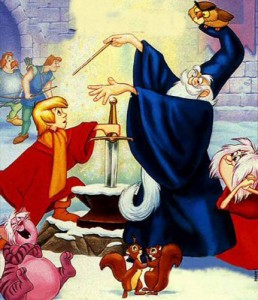
Yes, money exists in the physical world; it has weight and density; we can feel it. At a point in the not-so-distant past, it was even made up of (materially) valuable resources. But the money we worship, as it is, is of no intrinsic value. It’s what that money becomes that gives it worth. Money is a shape-shifter; it is Mystique, The T-1000, Merlin, Professor Lupin; it can be anything.

The famous shape-shifting wizard, Merlin - as seen in Disney’s Sword in the Stone.
The famous shape-shifting wizard, Merlin – as seen in Disney’s Sword in the Stone.

It can be a night downtown, complete with bottle service and a booth to call your own. It can be a new book, the smell of fresh pages still intoxicating in their strength. It can be a water pump for a thirsty village in Africa. It can be a lady of the night, or a donation to the church. It can be tickets to the show, the game, or to get on the overnight train to visit an old friend. It can be a university education or a down payment on a house. Money, simply put, is a promise of the future.

And that is why it is such a terrifying thought to spend one’s life pursuing it.


There is nothing less material than money, since any coin whatsoever (let us say a coin worth twenty centavos) is, strictly speaking, a repertory of possible futures. Money is abstract, I repeated; money is the future tense.” – Jorge Luis Borges, Labyrinths.


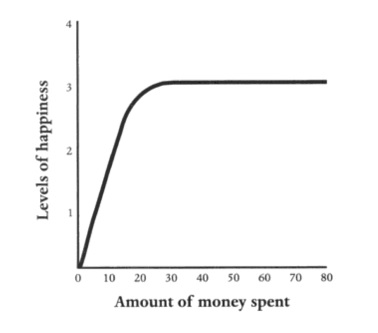
I’m not so naive as to think money isn’t important. It serves its purpose, and can be put to use in some pretty amazing ways. I, like Epicurus, tend to believe money has a limited role to play in our happiness. It can give us the food and shelter we need to survive, or the education we require to follow our dreams. It can cover the cost of rent for your new yoga or art studio.

The Epicurean graph of Money vs Happiness, as found in Consolations of Philosophy by Alain de Botton
The Epicurean graph of Money vs Happiness
, as found in Consolations of Philosophy by Alain de Botton

But it will never make us truly happy.


Why it’s crazy

It seems almost ludicrous to think money will lead to our happiness. Spending one’s life chasing the accumulation of money, or the material items that money can transform into, is perpetually pursuing the future. There is no life, no experiences, no love, or laughter in the future. Those things are found in the present moment; they are found in the here and the now.

It’s been said that the minute we fulfil a fantasy we can not, and will not, want it any longer. This is because it is never the material desire that we want, it is the fantasizing about that desire that we seek. Think of the time you fantasized about being single, getting a puppy, or buying that new car. If I could just obtain “x”, you thought, I`ll be happy – only to find out that happiness doesn’t work that way. Even a small child desires the shiny red ball or those magically rattling car keys, until he or she obtains them. We may get a brief fulfilment out of finding a new (or multiple new) partner(s), playing with the new pup, or wheeling around in the new whip – but that novelty will always fade. It fades because these things only serve to plug a hole inside of ourselves, a void that can only be filled from within.


This is why money – and the pursuance of it – it such a foolish prospect.

If we spend our days accumulating money, we’re spending that which gives money value in the first place – our future. We’ll have many coins that can turn into many things, but with no time left to perform such powerful magic. Our future, much like the money we attain by wasting it, is not something we can bring with us after we pass from this life.

A fulfilled life isn’t measured by the number of fantasies you fulfil or the material objects you obtain. It’s measured by the experiences you have, the people you share it with, and (most importantly) being fully present in those moments. Spend your time in the future, or chasing it, and you’ll miss the collection of moments that fulfil us, the ones that pave our way to happiness.

Don’t spend your life in a constant chase of the next future fantasy. Chase the present moment. Live in it fully, love in it fully, and laugh it in fully. Your happiness is not a fantasy to be fulfilled. It is right in front of you this very moment.

Take it, its yours.

Be good to each other,

– MG.
On Sincerity:

I’m not talking about the superficial sincerity you try to muster into your facial expression when you tell your friend their dodgy haircut looks great. It’s not in the tone you try to force into your voice when you tell your significant other they didn’t burn the (completely black) steak and that it tastes fine.

Growing up, we all picked our sides; cowboys or indians; ninjas or samurai; the (very talented) blue players or the (slower, less skillful) red players on a foosball table.

As much as I loved those genetically mutated turtles who ate pizza and ran rampant in the sewers, I was never really a ninja kid. Personally, there was something about the samurai class that I was always drawn toward. This affinity for the samurai travelled with me well into adulthood. There was a certain romanticism about them. They were, to me, the very definition of warrior poets.

I studied Bushido (the way of the warrior) which inevitably led me to stumble upon Yamamoto Tsunetomo’s work, Hagakure: The Book of the Samurai. I found that the more I read, the more disappointed I became. The teachings were often elitist, sexist, selfish, ruthless, and sometimes extremely barbaric.

A player from team blue with the foosball, presumably about to score due to poor red defending.

I found myself able to forgive these massive flaws, however, when I put everything into the proper perspective. These men were not by nature the skilled killers they had become famous for. They were born the same as you and I.

These men could be our fathers, our brothers, our husbands, or our boyfriends. These men were capable of love, compassion, mercy, and generosity. I found it fascinating that they were able to completely transcend their humanity in becoming samurai. I felt myself drawn to the teachings that helped these men – who were people just like you and I – rise above the human restrictions they were born with.

Most of us have no desire to transform ourselves into heartless marauding mercenaries, myself included. That doesn’t mean there are no important lessons to take from Hagakure and the legendary code of the Samurai.

I think we’re all looking for a higher version of ourselves. We all have a deep seated desire to become someone that reaches beyond the limitations we’ve all convinced ourselves we have. Yamamoto’s teachings emphasised a single word that, until that point in my life, I had never placed much importance on.


the_little_samurai_by_azertip

There will be many giants for us to face in this life; we must face them like samurai; we must face them with sincerity.


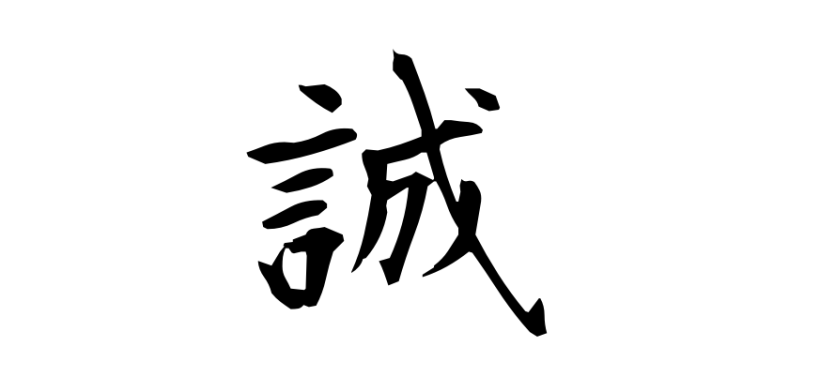
In the Hagakure, the importance of sincerity is constantly stressed. It emphasises the absolute necessity of sincerity in not only self improvement but in all aspects of our lives.

I’m not talking about the superficial sincerity you try to muster into your facial expression when you tell your friend their dodgy haircut looks great. It’s not in the tone you try to force into your voice when you tell your significant other they didn’t burn the (completely black) steak and that it tastes fine.

I’m talking about true sincerity, the kind that can only flourish inside of you. You can put on a Leonardo DiCaprio-esque performance to the rest of the world, but you can’t fake true sincerity to yourself. There is no such thing as almost sincere, or partially sincere. Whether it’s an action you’re taking, a plan you’re making, or words you’re speaking, you either absolutely mean it with every last fibre of your being, or you don’t.

Sincerity does not only complete the self; it is the means by which all things are completed. As the self is completed, there is human-heartedness; as things are completed, there is wisdom. This is the virtue of one’s character, and the Way of joining the internal and external. Thus, when we use this, everything is correct.” – Yamamoto Tsunetomo, Hagakure: The Book of the Samurai.

It is an extremely simple and logical concept. Sincerity is the distinguishing factor between those who actually want something and those who only claim that they do. Many people wish to lose weight; those who take it upon themselves to research proper nutrition and exercise before implementing what they’ve learned into their everyday life exemplify sincerity. Those who take the option of a gluten free bun for their burger, before adding a large fry and a coke, are those who are demonstrating insincerity. Sincerity will quickly show you results and insincerity will leave you wondering why you’re not achieving your goals.

The samurai, for example, were so sincere about living an honourable life that they would actually disembowel themselves – a practice known as seppuku – rather than shame themselves in battle or die a dishonourable death. This practice is actually one of the things I found barbaric about the samurai, but there is certainly no denying the absolute sincerity by which they lived their lives and by which they honoured their code.

They were willing to sacrifice (literally) everything to obtain and maintain something as intangible and obscure as honour in their lives, while most of us couldn’t even give up chocolate for lent. Through sincerity they were able to completely transform their human selves into automatons of destruction. Sincerity was the power behind their ability to become the fearless, emotionless, masters of death that they were.

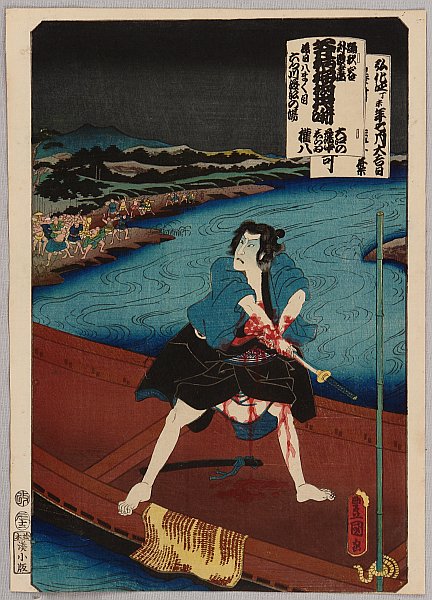
Suicide by River - Kabuki (1856) by Utagawa Kunisada
Suicide by River – Kabuki (1856) by Utagawa Kunisada

Sincerity is present in every aspect of life. In sports, sincerity lives in the child who gets excited for practice, who studies the game. Insincerity lives in the child who’s playing because his parents want it for him, or because it could translate into millions of dollars. Insincerity exemplifies itself in the workplace, in those who switch onto autopilot for forty-plus hours a week in a job they chose because there was a market demand or because it sounded prestigious. Sincerity emits from the ones who jump out of bed in the morning because they’ve chosen to do something they love, regardless of the money they make or the status it brings them.

The more we look for sincerity, the more apparent it becomes. The more we act with sincerity, the more we’ll develop a reciprocal relationship with it. When we act out of sincerity, sincerity acts back. It acts back in the form of noticeable improvements, lessons learned, successes, and (most importantly) failures. These failures tell us we’re on the right path, they tell us we’re going in a sincere direction.

When we speak with sincerity, sincerity responds. It responds in the form of advice from others, grapevine opportunities, offers of help, and real talks with those around us. When we love others with sincerity, with all of our soul, our lives become full of love that is – in turn – sincere.

Life becomes simple when you live it with sincerity. Be sincere with every one of your actions and words. Be sincere with those around you. Most importantly, be sincere with yourself.

And you’ll find the life you attract is sincere to you.

Be good to each other,

– MG.
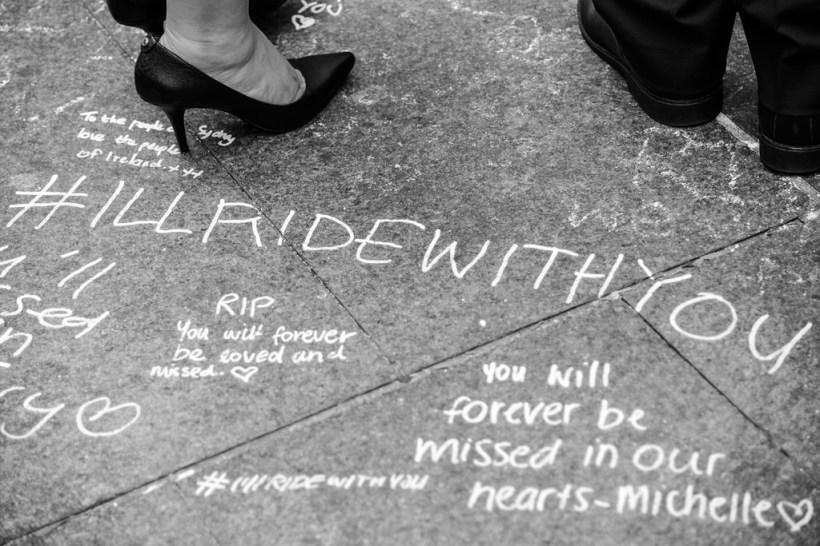
Photo of giant samurai courtesy of: azertip.deviantart.com

On Pain:

What if pleasure and displeasure were so tied together that whoever wanted to have as much as possible of one must also have as much as possible of the other — that whoever wanted to learn to “jubilate up to the heavens” would also have to be prepared for “depression unto death”?” – Friedrich Nietzsche, The Gay Science.

The buzzing of the planet is a daily reminder of our mind-bending advances in technology. Our satellites glimmer amongst the stars in the evening sky, a sky that plays host to thousands of soaring planes during the daylight hours. Our technological prowess has vastly increased the comfort of our daily lives. Like most things, however, our technology comes with a cost. Everything from iPhones to automobiles cost us money, which puts a price tag on the comfort and convenience they provide us. Comfort has thus become a thing of value. It has become important to us.

The importance placed on comfort by our society has inspired in us a ruthless seeking of it. We centre our lives around obtaining things that will aid us in avoiding discomfort, pain, and suffering. Yet I’m beginning to wonder if this spread of a certain Epicureanism throughout the western world has actually bettered our lives, or if it’s part of the reason we live such unfulfilled and relatively unhappy lives.

Flashback nearly two years ago, to my life of comfort. I was the Dionysus of an eastern Toronto suburb and my basement apartment man-cave served as my Olympus. I lived at home rent free, had no university debt, and was earning a full-time wage I could have saved to buy a house and a car with. I had nearly a dozen close friends close by, whom I had grown up with on the ice rinks and considered them more like brothers than friends. I had the best all-you-can-eat sushi joint just around the corner from my house. I had a gym buddy who was actually a ninja. I possessed the disposable income to do and purchase essentially whatever I pleased. I was a tree of comfort, and my roots were strong and deep. Life was painfully easy.

But I was unhappy. I was stagnant. I was unfulfilled.

An artist's rendition of my training partner. [Source: Hokusai Manga (1817) by Hokusai.]
An artist’s rendition of my gym buddy.
[Source: Hokusai Manga (1817) by Hokusai.]
Fast-forward to the present. I have long since left my job, friends, and family. I have vacated my Mount Olympus throne to travel across the Pacific ocean. I traded a life of comfort for the pursuance of something more. As of now, I’m uncomfortable, but I’m happy and feeling more fulfilled every day. I wouldn’t disillusion anyone and say anything about this has been easy, comfortable, or painless. Law school is a grind. Money is tight. I’m homesick. I miss my sisters, my mom and dad, my band of brothers/thieves/merry men. And I haven’t seen a single ninja since I landed here.

Yet is that pain and suffering not the price we pay for fulfilment, for happiness? Isn’t that our inherent agreement with the universe we are a part of? I look around myself and see that we naturally understand this contract.

I’ve seen “No Pain, No Gain” on gym singlets and “Pain is Temporary, Glory lasts Forever.” splattered on dressing room walls. I see all of us – the warriors of love – seeking out a significant other regardless of the pain relationships have caused us in the past, or the heartbreak we could be forced to endure in the future. We take the tests regardless of the chance of failure, or the immense effort required to study and learn. We play our various sports, knowing we’ll be bumped, bruised, and judged. We train our bodies to be strong through toil, trouble, and tears, even though they will eventually wither under the taxes of time. We paint, write, and dance, undeterred by the visions of the starving artist. We love our families and friends to the fullest, knowing the pain we’ll feel when they are inevitably taken from us. We do these things because we innately understand the nature of fulfilment.

What if pleasure and displeasure were so tied together that whoever wanted to have as much as possible of one must also have as much as possible of the other — that whoever wanted to learn to “jubilate up to the heavens” would also have to be prepared for “depression unto death”?” – Friedrich Nietzsche, The Gay Science.

We know that the treasure of fulfilment is closely guarded by pain, suffering, and discomfort; the three heads of a hellhound protecting the gateway to happiness. We know that the most uncomfortable places are the classrooms where we learn and grow the most. We know that catching that perfect wave is worth the endless paddling, the hours of waiting, and the salt we get in our hair. We understand that the discomfort of rising in the early morning is the price of watching a stunning saffron sunrise. We know that trading the uninspiring view from base camp for the breathtaking scenery of the summit requires hours of treacherous hiking up the side of the mountain.

I think it’s entirely possible to live your whole life in comfort, confronted by minimal pain and suffering. I think this very moment there are many people who are dying in their retirement home beds who managed to accomplish this. I also believe that those same people would be willing to trade all of the days they lived in comfort for one chance to go back to their youth. They would go back and put themselves directly in the path of that same pain, suffering, and discomfort they have avoided all these years. For in doing so, they would also risk a life of happiness and fulfilment.

Don’t settle for comfort. Take the risk. Catch that perfect wave. Watch the sunrise. Fall in love. Climb that mountain.

…..I do miss that sushi joint though.

Be good to each other,

– MG.